Ongoing Projects
Our lab focuses on the intersection of condensed matter physics and quantum technologies. We are actively investigating novel topological materials and 2D systems.
- Topological quantum materials for next-generation spintronic devices
- Spin texture engineering and characterization in topological materials and hybrid perovskites
- Quantum rectification and development of hardware for 5G, 6G, and THz technologies
- Building Device architecture for the foundational components for quantum communication and computing
Funding Agencies




Research Themes
Quantum Nonlinear Transport
RF Sensing & Energy Harvesting
SOT-MRAM & Spin Mapping

Quantum Technologies
Research Highlights
Quantum Nonlinear Transport
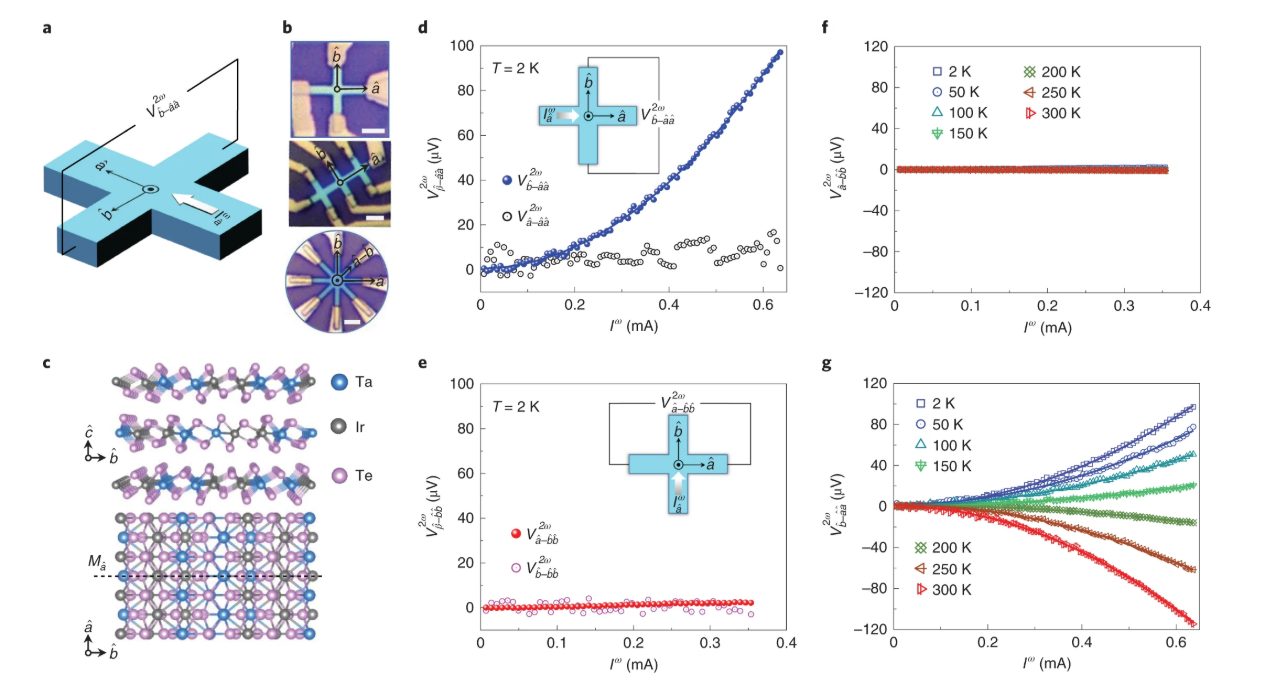
We demonstrated robust nonlinear Hall effect in the type-II Weyl semimetal TaIrTe4 at room temperature. This is driven by broken inversion symmetry and large band overlapping at the Fermi level. Based on this observation, we created a wireless RF rectification device that functions at room temperature without external bias, paving the way for micro-scaled energy harvesting devices.
Ref: Room-temperature nonlinear Hall effect and wireless radiofrequency rectification in Weyl semimetal TaIrTe4", Nature Nanotechnology (2021)
SOT-MRAM & Spin Mapping
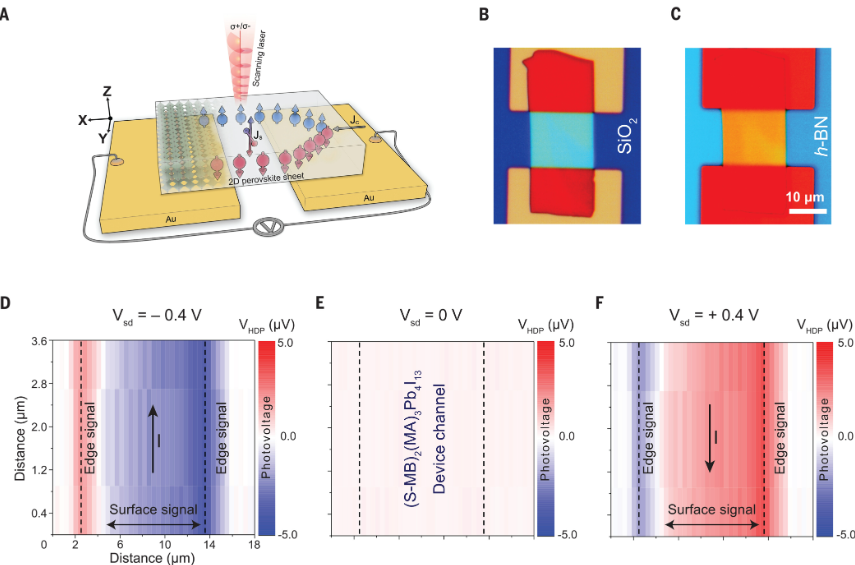
We demonstrated highly efficient electrically driven charge-to-spin conversion in enantiopure 2D chiral perovskites. Using scanning photovoltage microscopy, we measured a massive spin Hall angle of 5% and confirmed the existence of both conventional transverse spin current and collinear spin Hall conductivities, establishing these crystals as emergent spin-optoelectronic materials.
Ref: Two-dimensional chiral perovskites with large spin Hall angle and collinear spin Hall conductivity", Science (2024)
Quantum Rectifier
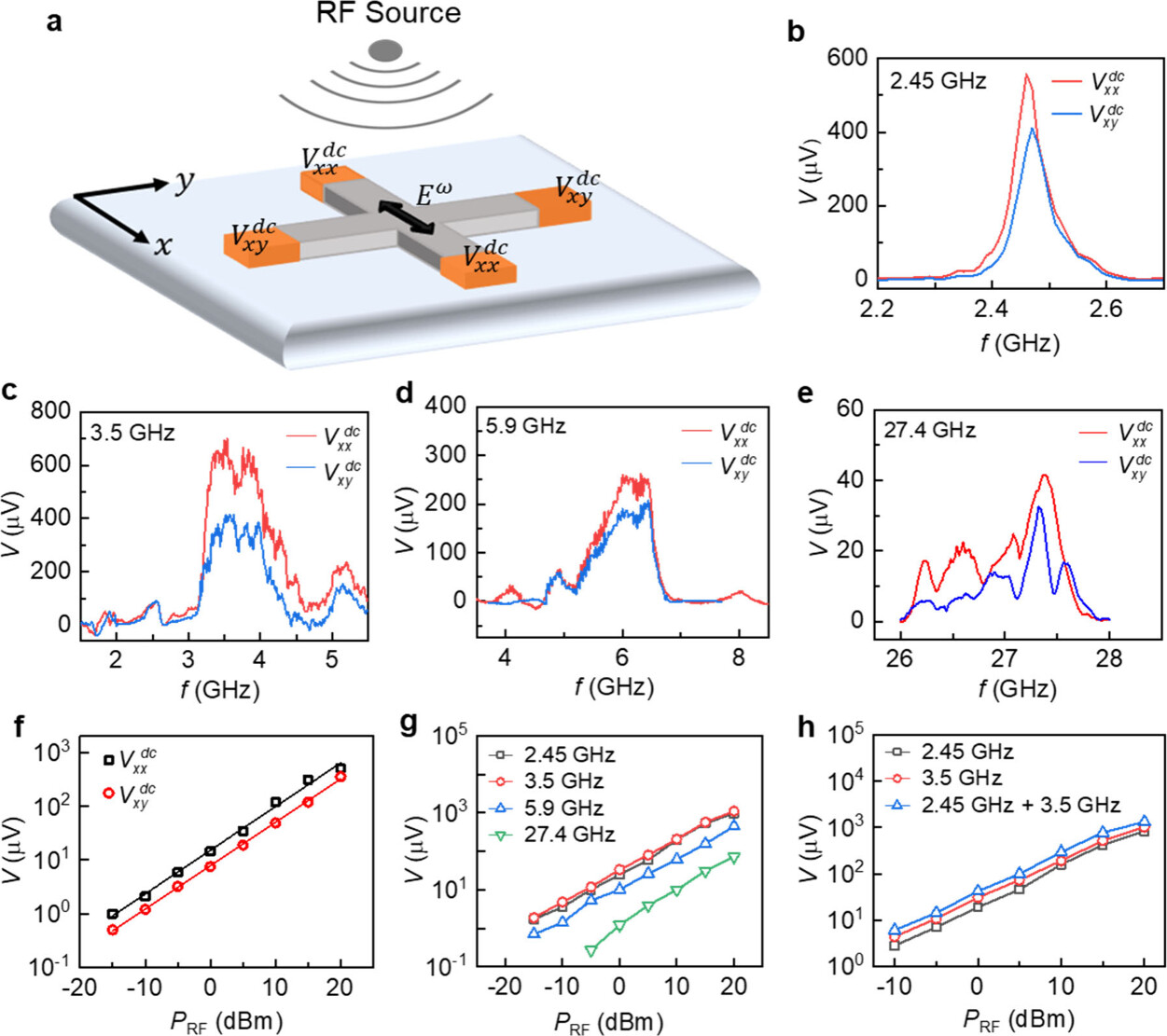
Unlike previous materials showing rectification only in the transverse direction, we discovered that bismuth telluride (Bi2Te3) demonstrates robust second-order voltage generation in both longitudinal and transverse directions. This multidirectional nonlinearity enabled a quantum rectifier effective from Wi-Fi bands (2.45 GHz) up to 27.4 GHz, ideal for next-generation 5G energy harvesting.
Ref: Quantum Rectification Based on Room Temperature Multidirectional Nonlinearity in Bi2Te3", Nano Letters (2024)
Quantum Technologies
A major challenge in scaling quantum networks is the noise generated when high-power classical fields interact with phonons in shared optical fibers. We modeled this interaction using a random Hamiltonian and proposed a novel control method using a counter-potential to significantly mitigate this interaction noise. This ensures high signal integrity for Quantum Key Distribution (QKD).
Ref: Quantum-classical interaction noise and mitigation in shared optical fibre system", Journal of Modern Optics (2026)